
Cryptid Profile: The Wendigo
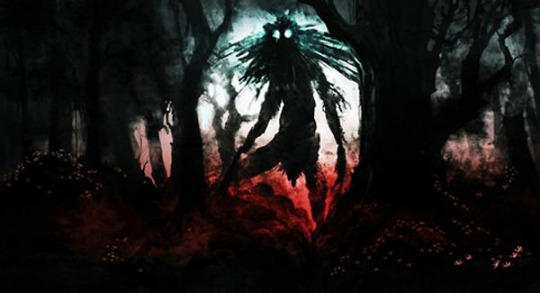
As most everyone knows (and by everyone, we mean the followers of this site and others like it), the Wendigo is a monster cannibal that loosely resembles a human/deer hybrid and stalks the frozen woods of the north looking for human flesh to consume. It has quickly solidified itself in the folklore of old and modern times, and has become somewhat of a tent pole creature within the realms of cryptozoology, fortean zoology, and paranormal studies. But what exactly is a Wendigo and where did it come from?
The term Wendigo is essentially an umbrella name for one ancient “creature.” Many Native American tribes (Chippewa, Ottawa, Algonquin, Potawatomi, Cree, Naskapi, etc.) across North America had a word within their language to describe what they considered to be “monsters” or “boogeymen” of the woods. The words for these creatures varied by tribe depending on location within North America, but they all roughly sounded the same. These words are as follows: Wiindigoo, Wendigo, Weendigo, Windego, Wiindgoo, Windgo, Weendigo, Wiindigoo, Windago, Windiga, Wendego, Windagoo, Widjigo, Wiijigoo, Wijigo, Weejigo, Wìdjigò, Wintigo, Wentigo, Wehndigo, Wentiko, Windgoe, Windgo, Wintsigo. Windigoag is a plural form (also spelledWindegoag, Wiindigooag, or Windikouk.)Depending on where you were at, each of these names would roughly translate into dark and ominous sounding terms, “the evil spirt that devours mankind” or “he who lives alone” and “spirit of the lonely places” as examples.
Now that we know how many names there are for this being, what did it look like to the native tribes who spoke of it? What stories were told about it? Again, depending on where you were located within North America, the Wendigo could often be described quite differently, but it was always described as cannibalistic. Some would describe the Wendigo as a completely dark and evil spirt without form, it was the complete opposite of all things good in the world. It was placed directly on the earth by the Creator, just as all other creatures were. Another description says that the Wendigo is a huge and gigantic skeleton (upwards of 20ft) that is entirely made of ice and snow. It has bones made of flexible ice and stands “higher than the treetops.” Yet another description claims that the creature is reminiscent of a walking corpse. It has sickly yellow skin covered in patches of fur, long fingers, spots of long stringy hair, and noticeable bones underneath. It sometimes was described as having bone like horns upon its head as well. The final (and most recognized) version of the Wendigo is very much human looking in appearance except for some monstrous traits. It had arms that appear to be too long for its body which connected to hands adorned in long claws, it is missing its lips which more clearly show a mouthful of jagged teeth and fangs. Its tongue is long and like that of a dog. Its eyes were sunk deep in its skull. It was always naked and covered in dead plant material from the swamps. It’s eyes were red and glowed like a dying fire. It’s heart was made of ice and it pumped ice through its veins. To look upon this version of the Wendigo meant instant death for the unfortunate soul.
Most tribal stories that spoke of the Wendigo talked about how it had a never ending hunger for human flesh. The more it consumed, the bigger it got which in turn meant it got hungrier which then caused it to need to devour more humans. Upon becoming more powerful, the monster could begin to influence people with its voice, almost hypnotizing them to come to it. The creature could send its voice through the wind into the ears of a man or woman within the woods. The unfortunate victim would follow the call of the Wendigo right into its trap where it would then become food for the insatiable monster. Along with the power of a hypnotic voice, the Wendigo could also perfectly mimic human speech. With this ability, the monster could lure unsuspecting victims deep into the woods under the belief that they are following a loved one or a friend. The tragic nature of this deception means the unlucky soul was doomed by their own loyalty. The stories claim the creature to be at its most powerful during the winter months, because it is at this time where food becomes scarce for every living thing, driving the need for possible cannibalism higher. It is this last sentencethat starts us down the road on how a person can become a Wendigo. It was commonly believed that if anyone, no matter how desperate the food situation had become, were to resort to giving into the deplorable act of cannibalism, that person would begin their transformation in the creature known as a Wendigo. The first taste of human flesh would take them down a path of likewise insatiable hunger and a constant desire to eat the meat of humankind. It is this reason why many believed that in a situation that resulted in starvation, it was more honorable to kill oneself rather than become a monster. The other way to become a Wendigo was to escape an attack by an already created monster. If a victim were able to avoid being eaten, but was instead bitten or scratched by the beast, they too would become a cannibalistic Wendigo (much like that of a werewolf).
Many hunting parties of the tribes in the area of the Wendigo spoke about how they encountered giant, dark and evil looking figures amongst the trees when they went out into the woods. They would talk about giant figures watching them from behind trees and from within caves and from high up in treetops. They would report gigantic prints in the earth that would lead into areas not often stepped upon. The dark figures would sometimes clash with the hunting party causing them to flee back to their camps so as to avoid becoming a Wendigo themselves. It was because of these encounters that many Native Americans would avoid certain sections of the forest. They believed they belonged to the Wendigo and if they respected its boundaries, it would let them be and would move on to other tribes in the area.
So why do we now only call this creature Wendigo instead of one of its many other names? The answer can be traced back to European settlers of North America. When the settlers arrived in the upper north of what would someday become recognized as North America, they had standard run-ins with the native tribes of the surrounding area. Naturally, they would hear the tribal dialect and words and would slowly begin to “understand” the meaning behind them. During the 1860’s a German explorer finally translated what he believed was the “modern” word for Wendigo after speaking to and learning about it (and the stories) from the tribes along the Great Lakes region. The word he believed it represented was cannibal. All other variations of the tribal word were then known by one overall term, that being Wendigo.
After settlers learned about the word (Wendigo), as well as hearing some of the stories regarding the creature, they began to incorporate the monster into their own stories. The cannibalistic monster soon moved out of the woods and into the logging camps on the outer edge of the forests. It slowly crept into the newly built villages. It dragged its way out from the dark swamps and into the cabins of the newly arrived settlers. The Wendigo officially became the new boogeyman to the new inhabitants of North America.
As the stories of the Wendigo started getting passed around newly built settlements and logging camps, soon did the reports of people actually encountering the monster. The fear of the unknown woods was beginning to take hold of some of the new settlers and they incorporated their new boogeyman into the main role of their unknown fears. If someone was to come across the corpse of an unfortunate soul who happened to perish in the woods (either from disease, exposure, or animal attack), they would blame the Wendigo. If someone (or multiple people) was to go missing deep within the woods, it was not due to their own negligence for not sticking to the path, it was because the Wendigo got them. If multiple deaths would happen within a single town relatively close to one another (likely due to a spreading illness or localized famine), it was because the Wendigo crept into town during the night and killed them. It was because of these incidents that the monster soon started becoming thought of as some kind of harbinger of doom and death, almost like a modern banshee of the Northwood’s. People claimed to see the Wendigo floating into houses to take the souls of the damned back with it under the cover of the night sky. Others claimed to see the monster standing within the tree line on the edge of a village or town, just watching and waiting to bring death upon it.
Many people of the area told the tales of the Wendigo to their children to pass along the taboo of cannibalism and how to avoid it at all costs. The stories became more frequent as the harsh winters hit the area and food sources became scarce. It was during these times that many villagers and townsfolk were confined to their dwellings for an overextended period of time. Within these walls, family and friends would die due to lack of supplies (if the family was not ready for the cold long winter) as well as sickness. Due to the lack of food, mental decay due to isolation, and the constant battering of the outside elements, meat (no matter where it came from) would look appealing to anyone. It is believed that the fear of becoming a monstrous Wendigo kept many from partaking in this grisly meal.
As the years passed and the 1900’s were fast approaching, the cannibalistic boogeyman stories became more well-known and re-told amongst the people who called the upper north woods home. They were passed down from the elder townsfolk to the new children of the area. They were told as warnings to avoid getting lost in the woods and to keep a good eye on your surroundings, they were told by lumberjacks in the area to explain things they could not rationally explain, they were told as bedtime stories to children who would not listen to their parents. A select few people decided to use the legend of the Wendigo, passed down through family stories, as a way to make money. Stories were turned into books and the monster was now able to reach more people through the written word, bound and sold. One of the most popular stories to introduce the masses to the monster cannibal was “The Wendigo” and it was written by Algernon Blackwood in 1910. It is believed that Blackwood is the main author who ushered in the modern depiction of the creature that is now well recognized in modern society.
In Blackwoods story, a group of five men go out Moose hunting deep in the Canadian wilderness. While out in the woods, the men remember stories they heard about a creature said to roam between the trees. Even though they are a bit scared, they decide to split into two groups so as to increase their chances of taking down a moose. When one of the men randomly decided to take off running into a section of dark woods, another member of the group decides to chase after him. While chasing the first man, the second notices the strange tracks the first man is leaving behind in the snow. He also notices even stranger tracks mixed among the other ones, he then quickly realizes that the first man is chasing something monstrous. He notices a strange and unsettling odor in the air, but he decides to keep chasing. Eventually the second man meets back up with the other group at camp, but he is alone. And the other members of the group quickly notice that he is acting strange, different, almost as if he is changed.
It is often thought that Blackwood got some inspiration for his book from a real life event that took place in 1907 in Canada and involved a 87yr old Cree man named Jack Fiddler and his son Joseph. During their murderous stretch, Fiddler claimed to have killed 14 people that he believed were in the process of transforming into Wendigo’s. Eventually authorities were able to track down Jack and his son and throw them in prison. The courts could only directly link them to one of the 14 murders, it was that of a Cree woman who he claimed was on the verge of becoming a ravenous monster. Fiddler and his son pleaded guilty to the crime, but made it well known that what they did was to prevent an even larger tragedy from happening to the rest of the tribe.
It is from Blackwood’s classic story, and others like it that were published throughout the years, that modern audiences grew to know about the Wendigo as strictly a monster that lives in the woods and eats people. They long forgot about its ties to Native American stories of giants and evil spirts. Few hardly knew how it was once thought of as a boogeyman or ghostly death omen. It had now become a monster amongst other classic monsters. It was thought of no differently than that of the menacing sea serpents of the open oceans that many have claimed to see, or like that of the Jersey Devil of the great pine barrens that has terrorized the locals since the night of its birth. Simply put, it had become a modern monster. It is at this time that the Wendigo started to take on some more horrific qualities as well. The monster soon was described and depicted as having a decaying deer head (or skull) sitting upon a human-like body. You could see into its body through gaping wounds in the skin between its thin and cracked bones. It was a chilling hybrid of man and beast with elements of the supernatural and undead sprinkled in for good measure. Because if you are going to create a horrifying monster that promotes cannibalism, you often try to depict it as terrifying as possible.
So how does the Wendigo relate to cryptozoology? This is the question you are probably asking yourself because everything you just read about up top. From first glance, it appears that the Wendigo is nothing more than a story designed to scare away people from the horrors of cannibalism. Which if you look at it that way, becoming an insatiable monster doomed to eat human flesh forever is a good way to scare some sense into people and keep them from eating people. But what about the stories of people and Native Americans encountering evil giants within the woods? That is where cryptozoology starts coming into play. Many cryptozoologists believe when Native Americans were talking about Wendigos, what they were actually referring to was Sasquatch. This could explain why settlers of the time also told seemingly genuine accounts of how they often encountered or came across a large, evil looking figure deep within the woods that somewhat resembled a large manlike thing. The descriptions of the Wendigo, what with their giant stature, sunken eyes, long arms, long stringy hair, patches of fur on the body and long fingernails sound extremely familiar to various accounts of Sasquatch. A Bigfoot would easily tower above local natives of the time, in the early 1800’s most Native American men (depending on the location) stood only around 5ft 7in. A Sasquatch would stand around 8ft tall, thus making them a giant to frightened witnesses. The startling long arms tribe members would talk about the Wendigo having, these are also often described in modern Sasquatch encounters. Their arms usually hang down around their knees. It would also not be unheard of for a sasquatch to have longer fingernails. What about the patches of fur reported on the body of a Wendigo? Bigfoot reports often talk about how the creature is covered in hair except for patches on the chest, face, feet, and hands. How do you explain the stringy hair? Many who have had encounters with Bigfoot talk about how the hair upon its head and parts of the face are much longer and thinner than the rest of the body. If they were to encounter a male Sasquatch, the stringy hair the tribes members were describing could easily be the beard like facial hair of a Bigfoot. Deep sunken eyes? Reports of Bigfoot describe them has having a prominent brow above their eyes given them the appearance of having their eyes sunk further in their skull than normal. As for the footprints the hunting parties would come across, well this one speaks for itself. Most sasquatch prints can measure upwards of 22inches.
Does this mean that a Wendigo is a cryptid? This one is a bit harder to answer because it can be both yes and no. If you are describing a Wendigo type creature that more than likely is a Sasquatch, yes, it would become a cryptid. Perhaps it is a sub-species of forest ape, appearing to be in the same family as Bigfoot, but not entirely. If you are describing the Wendigo that has supernatural abilities, grows larger with every person it consumes, and is made of ice, the answer is no. This would not be considered a flesh and blood cryptid. It would now become a creature within the realm of Fortean Zoology (or the study of creatures that are not animals at all, but entities or apparitions which seem to have animal form. A blend of paranormal manifestation and mythology). This would also make this version of the Wendigo fall into the category of the supernatural.
So now that we have thoroughly discussed the background information on the creature known as the Wendigo, it is up to you to determine how you would like to classify it within your own mind. Cryptid, apparition, supernatural entity, it doesn’t matter. Whatever the Wendigo is, is appears that it is going to stick around for some time.
-The Pine Barrens Institute
*Image Credit: Google








Do you have a strange tale, family legend, or odd sighting you would like to report? Get in touch with us here to share what you know!
Want more monster stories in your life? If the answer is yes, then make sure to check out our book ‘Monsters In Print: A Collection Of Curious Creatures Known Mostly From Newspapers’, available now from Amazon!
Make sure to also check out our shop for official PBI shirts, totes, buttons, and stickers!
“…many people were in their homes enjoying what they thought was just a normal evening. But when they ran outside to see what was the matter, and heard the ever-growing roar steadily moving closer towards them, they also caught sight of a strange object both rotating and moving through the sky above the trees.”